News
$900K grant paves way for Chesaning dam removal
By MICHAEL PETERSON,
Argus-Press Staff Writer
CHESANING - The Chesaning dam is on its way out after a $900,000 grant through the Clean Michigan Initiative will help push funding for the Shiawassee River Restoration and removal of the dam.
State Senator Roger Kahn, R-District 32, has been very involved in the project and was instrumental in the push for the grant, said Bob Grnak, Kahn's media coordinator.“We think its the most wonderful thing ever,” Village Manager Marlene Schultz said. “It's not like a loan we have to pay back. We really feel fortunate and if it wasn't for Sen. Kahn we wouldn't have had this.
Total cost of the restoration - including planning, engineering and construction - is about $1.7 million. In addition to the grant, funding also will come from private citizens, businesses, the township and village.The dam has declined to the point where maintenance and repair is not a practical option.Tom Meder, coordinator for the Shiawassee River Restoration Committee, said they have been working on this project for seven years.
“The dam was deteriorating and something had to be done,” Meder said. “It has been repaired over the course of the last 30 years, but it is beyond repair now. We are going to remove it.”Engineers have developed a solution that restores fish passage, creates new river habitat, interconnects fragmented aquatic habitat and preserves the impoundment needed for the Showboat Festival, while eliminating the long-term liabilities associated with a failing dam.
Meder also believes the restoration will help to boost tourism.
“It will become a really prolific fishery now and people will be coming to use it,” Meder said. “Our campgrounds will literally be more useable because we will have fish right up near the campgrounds.”Meder explained the Shiawassee River goes right through the Chesaning campgrounds and with the dam fish cannot swim near the camping areas.
The dam was built in 1863 to create power for the grist mill and was a key element to Chesaning's success as a lumber hub in the mid-1800s.However, the dam is most notably used today for the annual Chesaning Showboat Festival, which is a major aspect of the cultural identity in the village.Meder is hopeful the project starts in the fall.
Friday, October 31, 2008


Tuesday, October 28, 2008
Pearling your kayak
His bow pearled while he was surfing and he ended up missing the eddy because he was upside down.
Pearling refers to the action of the bow, or stern, of your kayak diving under the water instead of floating on top. Pearling can happen for a number of reasons and is sometimes even done on purpose. If your kayak suddenly pearls and you were not expecting it or take actions to bring the bow or stern back to the surface you will most likely either get quickly flipped over or sent straight over onto your face.
Pearling on a wave sometimes happens when the wave is too short for your kayak. If you find yourself in this situation you will need to constantly be on an edge and continuously carving back and forth on the wave.
Pearling on a wave can also happen when a wave surges and pushes you down further in the trough of the wave. The easy fix for when this happens is to throw your kayak up on edge. With minimal surface area on the edge of your kayak compared to large surface of the deck of your kayak the buoyancy of your boat should bring the bow or stern right back up to the surface in no time. The trick is to be able to do this fast enough that you don’t get blown off the wave or react quick enough that the bow or stern does not get shoved too far down.
Pearling in flat water happens when you are too heavy for your boat or too much of your weight is forward. The easy fix for this is to shift your weight further onto the stern of the boat. This makes it harder to take strong powerful strokes and makes balancing a bit more of a challenge but it usually keeps your bow above water. However, if you are trying to do a trick such as the Plowing Ender then you will want to keep as much weight as possible on your bow.
Entering or exiting an eddy is also a common place to pearl. This is especially true at high volumes where there is a much more distinct line between downriver current and eddy current. In order to keep your bow from pearling when crossing in and out of an eddy you will want to make sure you do a peel out and lean in the direction of the current you are going into. Punching straight into or out of an eddy in a high volume river or creek typically is a recipe for a flip. However, if you are in a low volume playboat or a squirt boat then this line between eddy and current is a playground, just like a good hole is to a playboater.
Some kayaks are more susceptible to pearling while others are designed specifically not to pearl. With big volume and rounded bows and sterns creek boats are much harder to pearl then other kayaks as flipping in a creek is never a good thing. The opposite of this is a kayak with very thin but wide bow and stern. This shape is typically found on play boats where getting and staying vertical is essential.
Supposedly the term pearl came from surfing where one would throw the end of their surfboard into the on coming wave in order to make the board dive into the water.
http://www.niftytricks.com/kayak/dic/pearl.html
Wednesday, October 22, 2008
Saturday, October 11, 2008
Maps along Shiawassee River
WaterWorksPark in Holly, Michigan Map (click on yellow pin icon)
View Larger Map
3 Tubes RailRoad Bridge on Shiawassee River Map (click on yellow pin icon)
View Larger Map
Fish Lake Road take-out on Shiawassee River Map (click on yellow pin icon)
View Larger Map
Wilson Lake off the Shiawassee River Map (click on yellow pin icon)
View Larger Map
Fenton Mill Pond on the Shiawassee River Map (click on yellow pin icon)
View Larger Map
Strom Park in Fenton, Michigan Map (click on yellow pin icon)
View Larger Map
View Larger Map
3 Tubes RailRoad Bridge on Shiawassee River Map (click on yellow pin icon)
View Larger Map
Fish Lake Road take-out on Shiawassee River Map (click on yellow pin icon)
View Larger Map
Wilson Lake off the Shiawassee River Map (click on yellow pin icon)
View Larger Map
Fenton Mill Pond on the Shiawassee River Map (click on yellow pin icon)
View Larger Map
Strom Park in Fenton, Michigan Map (click on yellow pin icon)
View Larger Map
Friday, October 10, 2008
Dress to swim - everytime you paddle
Cold water removes heat from the body 25 times
as fast as cold air.
http://www.enter.net/~skimmer/openboat.pdf
COLD WATER + NO PFD = NO CHANCE !
http://www.tc.gc.ca/marinesafety/TP/Tp13822/menu.htm
Do not consider air temperature when
estimating the risk of cold water immersion!
as fast as cold air.
http://www.enter.net/~skimmer/openboat.pdf
COLD WATER + NO PFD = NO CHANCE !
http://www.tc.gc.ca/marinesafety/TP/Tp13822/menu.htm
Do not consider air temperature when
estimating the risk of cold water immersion!
Thursday, October 09, 2008
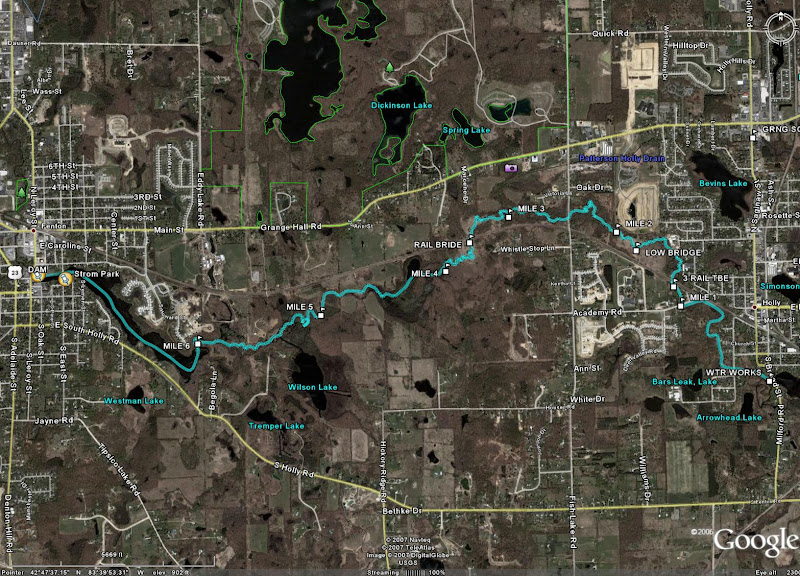
Map - Holly to Corunna

CLICK on photo to enlarge and zoom in
A tremendous amount of data available at :
http://gwmap.rsgis.msu.edu/viewer.htm
Map
 |
| From Shiawassee River - (Can't find it ? scroll down ) |
Click on the map to enlarge and zoom in
Waterworks Park in Holly
http://bbs.keyhole.com/ubb/showflat.php/Cat/0/Number/1244720/an/0/page/0
Strom Park in Fenton
http://bbs.keyhole.com/ubb/showflat.php?Cat=0&Board=EarthNature&Number=1244723&fpart=&PHPSESSID=
Wednesday, October 08, 2008
Paddling over a Dam - Just Plain Stupid
Michigan has about 2,500 dams, nearly 1,500 of them under six feet in height, according to the state Department of Environmental Quality.
Learn , study, take classes, paddle with friends, groups, etc.
Water is mischievous/ deceiving in the amount of power even light current has.
It' s a great article for discussion
http://www.mlive.com/flintjournal/index.ssf/2008/09/kayakers_death_in_shiawassee_r.html
And yeah, I did flip my boat in 32 degree water with a wetsuit on later that day below Delhi.
Fellow paddlers helped me out, no questions asked, no inquisition, just camaraderie.
We evolve and learn by taking risks while attempting to control as many external factors as possible.
Challenge people if they have safety equipment and why they aren't using it.
What's the worst that could happen...you get verbally abused for a second, so what.
I'm no paddling genius with an awesome roll and superman S on my chest, but I do care a little.
People also learn thru large paddle events -they see other boats, gear, equipment.
One thing that makes it tough is all the paddling/ rowing clubs are like islands.
Unless you visit (via e-mail) each club and invite them, it's tough to get a decent turnout.
Many don't even have webpages, they are just private lists of people who go out and paddle.
There is no one stop clearing house of paddling info in Michigan.
Canoe, kayak, sculling, whitewater, flatwater, surf, touring, racing, --thats a lot of territory !.
People are constantly buying boats and are in need of instruction, exposure to other boats,
safety protocols, in a nut shell " they don't know what they they don't know" .
How can you ask questions when your un-aware equipment like float bags exist for rec boats ?
If the guy at the shops like Dunhams/Dicks/ Cabellas etc. never told them the paddle can be offset for wind...
it all relates to a inherent problem with paddle sports in the Michigan-the land of water,water everywhere.
*When someone drowns falling off a powerboat because no vest is worn
-we the taxpayers pay for the body retrieval time, resources, etc.
No boatowner ever came up on murder one charges for negligent homicide,
had his boat impounded for the season, etc. etc.
We also pay monetarily when kayakers/canoeists do some foolish stuff.
Curious to hear comments, feedback, etc. either on the boards or via personal mail
Monday, October 06, 2008
Pics from 2008 Fall Color Tour Paddle

THANKS to all paddlers who came out
-- we had approximately 60 -70 kayakers/canoeists
and another big thank you to Heavners Livery
for additional rentals and shuttle service.
Sunny afternoon, light winds, temps in the mid 60's
all made for a great day.
Pictures of 2008 Shiawassee Fall Color Tour Paddle
http://outdoors.webshots.com/album/567721407KouRMx
Thursday, September 18, 2008
October 5th - Fall Color Paddle
Come join us for a 7 mile paddle in northern Oakland County
along the Shiawassee River for some spectacular fall colors.
Date : Oct 5th 1:00 PM
Launch : WaterWorks Park in Holly, MI
Finish : Strom Park in Fenton, MI
SHUTTLE service available
CANOE RENTAL is available thru Heavners on site that day
- WaterWorks Park - 602 South Broad St, Holly, MI 48442-1674
It's on Broad Street aka (Milford Road) in Holly
http://www.headwate rstrailsinc. org/images/ ShiawasseeRiverM ap.jpg
http://www.headwate rstrailsinc. org/images/ SE_Michigan_ Inset_Map. jpg
There will be a short presentation in WaterWorks Park, 602 Broad Street in Holly, at 1:00 pm.
about the Top of the Shiawassee Heritage Water Trail.
Participants will start from there at 1:15 pm and be off the river by 5pm.
The route is seven scenic miles from Holly to Fenton, which takes from 2 to 4 hours
depending on paddling speed.
Heavner Canoe Rental is providing canoes and kayaks for rent on site at approximately $40 apiece.
People who want to rent should make an advance reservation by calling 248-685-2379
and find out the exact price at that time.
Headwaters Trails will be providing return transportation
from Strom Park in Fenton back to WaterWorks Park.
People who bring their own craft are asked to make a
$5 contribution to that service; for others, transport is included in the price of renting.
The river is high at this time and clear of obstacles, so passage over beaver dams
and around tight corners should be fairly easy.
The event will take place even if the day is cloudy,
so participants should dress for the weather.
In the event of thunderstorms, we will, of course, cancel as the
final mile across the open Fenton Millpond could be dangerous.
However, the crisp air and the sight of fall foliage along the way make
this one last treat before the winter season sets in.
Come join us for "Canoeing in Color."
Headwaters Trails, Inc.
Sue Julian, President: 248-634-3513 : sjulian@provide. net
Doug Lanyk, Vice-President: 248-634-4551 : dslanyk@comcast. net
Background info
http://shiawassee- river.blogspot. com/
We're pushing for a Heritage Water Trail from Holly all the way to Bay City
Right now it's navigable from Holly thru Fenton, on to Linden and Argentine.
Thursday, September 11, 2008
Shiawassee River Task Force
Planning Activities
The Shiawassee River Task Force had its beginnings in 2000 with a Great Lakes Matching Grant from the Land Trust Alliance to Oakland Land Conservancy and North Oakland Headwaters Land Conservancy. The Task Force coordinates four conservancies in land protection and stewardship activities throughout the Shiawassee River watershed in Oakland County. Key partners include Oakland County Planning & Economic Development Services, Michigan Chapter of The Nature Conservancy, Michigan Nature Association, North Oakland Headwaters Land Conservancy, the Townships of Holly, Rose, and Springfield, and the Village of Holly. The local communities in the area have adopted innovative approaches to planning and zoning, such as cluster developments and resource overlay zones, to protect these sensitive features. Current activities include land and water trail development and continued protection and stewardship activities.
For More information please contact:
Shiawassee River Task Force
P.O. Box 51
Holly, MI 48442
Contact: Sue Julian, Coordinator
248-634-3513
sjulian@provide.net
Sunday, September 07, 2008


Tuesday, August 26, 2008
Kayak Raffle - Walden Adirondack
HeadWaterTrails Inc. in Holly,MI is raising money thru donations, grants and raffle tickets for a
Shiawassee River mid-point landing located on Fish Lake Rd. in Holly.
The group will be selling raffle tickets for a Walden Adirondack kayak and accessories.
Actual drawing will be held December 12, 2008.
HeadWatersTrails Inc. on the internet
http://www.headwaterstrailsinc.org/about_us.htm
-Sue Julian, President:
248-634-3513
sjulian@provide.net
-Doug Lanyk, Vice-President:
248-634-4551
dslanyk@comcast.net
WALDEN ADIRONDACK

The Walden Adirondack Kayak Is A Favorite For General Recreation.
It's Large Cockpit Allows Easy Access And Plenty Of Room.
The Adirondack Also Has An Optional Retractable Rudder
Put-In at Bush Park in Fenton
For those looking to launch their kayaks or canoes onto the Shiawassee River in Fenton,MI
--Bush Park offers a nice venue that is always open with no fees.
Bush Park launch site is best accessed off N. Leroy Street & 5th Street
View Larger Map
--Bush Park offers a nice venue that is always open with no fees.
Bush Park launch site is best accessed off N. Leroy Street & 5th Street
View Larger Map
Monday, August 25, 2008
Genesee Regional Trail Council
It would be really neat if the Genesee Regional Trail Council made trails happen along the Shiawassee River and the local lakes.
HeadWatersTrails Inc. in Holly works at getting trails connected
beyween adjacent communities for all to enjoy the great outdoors.
http://www.co.genesee.mi.us/gcmpc-plan/Files/Maps/Trails%20Maps%20Updated/Fenton.pdf
http://www.co.genesee.mi.us/gcmpc-plan/Trails.htm
http://www.co.genesee.mi.us/gcmpc-plan/Files/Docs/Trails/Approval%20Trail%20Plan%
U of M - The Southern Lakes Planning Initiative
Sara McDonnell
University of Michigan
Center for Applied Environmental Research
432 N. Saginaw St., Ste 1001
Flint, MI 48502-1950
810-767-7272 phone
810-767-7183 fax
smcdonne@umflint.edu
Sara McDonnell thru Southern Lakes Planning Initiative has worked with HeadWatersTrails Inc. in Holly, Mi and Fenton, MI
to conduct paddling inventories, identification of assets and developing strategies for branding the Water Heritage Trail .
http://www.oursouthernlakes.com/index.php?option=com_content&view=article&id=60&Itemid=72
Friday, August 15, 2008
Update - Shiawassee River Conditions
A review by Doug Lanyk from HeadWatersTrails August 14th, 2008
My how things change.
Jimmy and I Took a trip yesterday evening from
Holly's Waterworks Park to Bush Park in Fenton.
My expectations were slightly low water and an easy paddle.
So much for my powers of precognition.
The water level at waterworks park was about 3 inches higher
than I would have thought. The recent rainfall that missed
my house must have hit somewhere else in the headwaters region.
It was a good start to the journey. The river was quiet
and the wildlife was repeatedly surprised by us quietly
gliding down the river. Numerous deer, fish, turtles,
and heron were motivated to seek further cover upon
being observed at close quarters.
There is a tree partially blocking the river just after
the 3 tubes. You can still paddle around on the the shallow side.
It's small and will be easily removed, but beware if you try it,
it's covered in poison ivy. The quiet paddle was just about
perfect until another downed tree just before Fish Lake Rd.
Last week Jimmy had to portage the tree. Last night we had enough
water to bump over it. Once again it was smooth sailing.
The next item of note was the water level in Haddon pond.
It was noticeably lower. The beaver created marsh following the
pond had lot's of fresh bank showing and a bit of challenging
paddling to go around trees we are accustomed to going over.
The reason for the low water level was soon apparent.
The big beaver dam is gone! I don't know if it had help
but the center of the old dam is now completely washed out.
No drop whatsoever. This has aesthetic ramifications.
The old dump that comes up to the river at that point
is now showing a whole lot of garbage.
Some new work near Scarbury's Ford was noticed too.
The ford itself had low water and we had to bump our way across.
The last beaver dam before the Fenton Millpond has been beefed up.
It's now bigger and badder than ever before.
It's about a one foot drop that we skated over.
The millpond itself was a pungent mess. It is severely grown over.
It was a bit of work to get the boats across.
After dumping our first load of picked up garbage off at
Strom park we were rewarded for our work by finding a
blue grass band playing at the bandstand in Downtown Dibbleville.
As we portaged the dam, lot's of curious people questioned us
about paddling on the river. It was a good opportunity for
educating more people about our efforts. Below the dam
we launched Jimmy in his canoe just before I did a seal launch
off of the rocks. It was fun when the the crowd listening to the
band brokeout in applause and cheers in the middle of a song.
From the Dam to Bush Park was a bigger challenge than the millpond.
The water had disapeared. It was very shallow for most of the rest
of the trip. Where we did the cleanup a couple of weeks ago it was
hard to tell we had been there.
The trees that were totally submerged when we cut those above are
now completely above the water. More garbage has been exposed too.
By this time it was getting dark and we were glad that my truck was
right there. A longer trip would have been less than fun.
Get outside.
Doug.
Friday, August 01, 2008
Shiawassee River Trail connects to Lake Ponemah

***__Click on image for a full size view___***
--Look carefully to follow the Shiawassee River (blue line)as it connects to Lake Ponemah on thru Bush Park in downtown Fenton, along the old mill pond to Wilson Lake (follow Grand Trunk Western Railroad tracks) over near Holly and from the WaterWorks Park on Broad Street in Holly.
Thursday, July 31, 2008
Shiawassee River Trail gets longer
A big thank you goes out to all the volunteers who helped cleaning out the river in Fenton. Debbie (our organizer), Tom, Dave, Willi, Sharon, Pete, Jimmy, Sara, Andy, Maggie (our car spotter) and I got wet and had fun. At 6:00 we started in Bush park in Fenton and went up stream toSilver Lake Road. There were 3 major log jams and several smaller blockages to remove as well as a couple of bags of garbage, plus a chair, a bike, a municipal garbage can... Working near the park had it's advantages. We just had to bag the garbage and put it up on the bank in the park. The city of Fenton will pick the garbage up. By 8:30 we had made it back to our starting point. Several people had to head home at this point. Five of us continued on down stream to our trucks about half way to us 23. This portion had a cleanup a month ago. We still found a bag of garbage and a few trees to trim back. The river is surprisingly scenic for being in the city. There are only a few lawns in view considering we are in the heart of the city. Aside from the seasonably low water this will be a fun segment. There is a fairly brisk current moving you along. It was 9:30 by then and time to call it a day. Now the bad news. There is more work to be done. As near as I can figure we have 8 more blockages to clear on the way to Lake Ponemah. One of which is fairly substantial. The date picked to finish this off is Sunday August 3rd. More details to follow. Once again thanks for your support. We are within striking distance of having a 20 mile stretch of scenic river in paddling shape.
Doug Lanyk - HeadWatersTrails__Vice-President
Doug Lanyk - HeadWatersTrails__Vice-President
Wednesday, July 02, 2008
Outdoor Life Magazine
Hi, Willi,
We’re writing to let you know that your project has been chosen as one of this year’s Outdoor Life Save-a-Stream projects. We are excited to help you get your work started and to hear of your progress over the summer.A kit will be going out to you this week, containing stream restoration materials to help you in your efforts. It includes contact information as well, should you need to talk to someone about the project. You can also e-mail me if you have any questions.
Thanks for all the work you do to keep our streams and rivers clean! We look forward to seeing photos or video of your results and to sharing reports of your progress with our readers.
Sincerely,
Camille Rankin
Managing Editor
Outdoor Life
Monday, June 09, 2008
A story of boat names
Interesting story taken from a paddling magazine :
Nowhere did anyone say that a sea kayak is a CANOE with certain attributes. Nobody I know (with the possible exception of John Wilde) calls their sea kayak a canoe. If this is the case, why are all the bodies which oversee sea kayaking (Australian Canoe Federation, NSW Canoeing Board of Canoe Education, etc.) listed as CANOEING organisations?
Blame it on the POM’s (for our overseas web site visitors POM is an Australian name for English persons - not complimentary. Perhaps derived from early convict "Prisoner of Mother England”, thus POME, or more frequently, POMMIE **stard. May also be a corruption of "Pong", meaning to smell badly. Pom’s bathe only infrequently and NEVER wash their socks).
The bloody Pom’s, with typical Imperial hubris, simply called all indigenous paddle craft ‘canoes’ (which word comes from the Carib Indian ‘kanu’, later Spanish ‘canoe’). This linguistic arrogance also resulted in that transcontinental traveller, the short-tailed shearwater, being called a ‘Mutton Bird’ and the highly prized abalone a ‘Mutton Fish’. Perhaps all the bully beef had affected their taste buds.
Of course, for many years, explorers had been using native American canoes for their expeditions. These light, swift craft were ideal for the vast system of lakes, rivers and streams the New World offered. The Iroquois and Algonquins could quickly outdistance any European boats and were in demand for exploration. But when the white men and their Native canoeists met up with the Inuit in Northern Canada, the kayaks blew their doors off.
The Inuit could paddle away from the Algonquins even more easily than the Algonquins could swamp the Europeans. Instead of finding out the true name of these racy craft, the unimaginative and linguistically challenged British simply called them ‘canoes’. Now we are left with the problem of sorting out all this intellectual laziness. The Poms attempted to solve the dilemma by calling canoes ‘Canadian Canoes’. This may work in the UK and Australia, but brings blank stares in North America where a canoe is a canoe and a kayak is a kayak and all the canoes in Canada are Canadian.
The origin of the name ‘kayak’ is a bit obscure itself. Zimmerly used the title ‘Qajaq’ for his excellent book on the Kayaks of Siberia and Alaska. Qajaq is simply Inuit spelling for ‘kayak’. Of course the Inuit had no written language, and this spelling was invented by missionaries. Zimmerly doesn't mention where the word came from in his book. It could well have been a local name which was picked up by the white men and spread by them as a generic term as a matter of linguistic convenience.
If I understood Larry Gray correctly as he spoke about his Greenland experiences, sometimes each specific type and even individual kayak had a certain Inuit name. Chris Cunningham wrote “Qajaq shows up in HC Petersen’s ‘Skinboats of Greenland’ glossary as the Greenlandic term for a kayak.”
The Aleutian ‘Baidarka’ offers no clues. Baidarka simply means ‘small boat’ in Russian, the language of the first explorers of that vast chain of islands.
Monday, May 26, 2008
Riparian Corridor Planning

(click on the Shiawassee River Map to enlarge it full size)
Oakland County Planning and Economic Development
The unique opportunity within the river corridor is the ability to protect
significant natural areas before they are destroyed.
The relatively rural character also affords other opportunities
- such as trail development and natural areas management.
http://www.oakgov.com/peds/program_service/es_prgm/rip_green/rg_shiawassee.html
Key partners include Oakland County Planning & Economic Development Services,Michigan Chapter of The Nature Conservancy, Michigan Nature Association,North Oakland Headwaters Land Conservancy, the Townships of Holly, Rose, and Springfield, and the Village of Holly
Saturday, May 24, 2008
River races take place in Holly

By: Anna Troppens, Associate Editor
©Tri-County Times 05/24/2008
Holly - Douglas Lanyk, of Rose Township, doesn't usually get to participate in Headwaters Trails' Holly to Fenton Races and Pleasure Paddle. As a member of the organization, he's helping run the event. This year, Lanyk, who is vice president, was able to take his canoe along the route afterward, cleaning up any trash left behind (there was none) and checking for anyone who hadn't completed the course.
Lanyk's 90-year-old father, Louis Lanyk, (picture) was along for the ride in the same canoe. Louis gave the large canoe to Douglas 25 years ago. Louis taught Douglas how to canoe 41 years ago, Douglas said. His father hadn't been in the canoe for 25 years. "It was nice to get him paddling."
Thirty-eight total canoes and kayaks launched, carrying 47 paddlers. These included the afternoon Pleasure Paddlers. "It was a wonderful day," Douglas said. "You can't beat a day on the water." Participants enjoyed the diverse landscapes along the route and appreciated the trail work and race day support of the volunteers of Headwaters Trails. They spotted animals such as sandhill cranes, blue herons, turtles and muskrat along the way. "Normally, I see lots of critters out on the river," Lanyk said.
Wind was a big factor on the Fenton Millpond, the last mile and a quarter of the course. "It was warmer this year, but much windier," President Sue Julian said.Paddlers struggled against the 30 mph gusts to finish the course. "Nobody really appreciated the big breeze at the end," Lanyk said. Volunteers towed a couple of boats containing children, which were being blown around. But participants were happy. "Everybody I talked to had a big time, and big smiles," he said. "Even the people in the two canoes that tipped over were smiling at the end."
Monday, May 19, 2008
Race Results - May 18th, 2008 Shiawassee River
Race Results - scroll down for pics and videos
Experienced Class: 1st Place: Martin and Hunter Spees with a time of 1 hour, 28 min, 40 sec; 2nd Place: Lennie Brousseau and Collette Simerson with a time of 1 hour, 31 min and 25 sec; 3rd Place: John and Ben Cox with a time of 1 hour, 42 min and 25 secs.
Novice/Youth Class: 1st Place: Matthew Hill and Adam Schneider with a time of 1 hour, 51 min and 40 sec; 2nd Place: Matt Weber and Brandi Whiteman with a time of 1 hour, 55 min and 14 sec; 3rd Place: Louis and Bonnie Nickels with a time of 2hours, 18 min, 05 secs.
Solo Class (Kayak or Canoe): 1st Place: Ken Foss with a time of 1 hour, 29 min, 20 sec; 2nd Place: Justin Davis with a time of 1 hour, 31 min, 35 sec; 3rd Place: Mark Irish with a time of 1 hour, 32 min, 35 sec.
Thirty-eight total craft launched carrying 47 paddlers, including the afternoon Pleasure Paddlers. Everyone enjoyed the diverse landscapes along the route and appreciated the trail work and race day support of the volunteers of Headwaters Trails. The one wish was for less wind which was a big factor on the Fenton Millpond, the last mile and a quarter of the course. We hope 2009 weather will be more cooperative!
Webcam VIDEO & Photos - Shiawassee River Paddle Event 2008
Video of the racers on the Shiawassee River Water Heritage Trail
http://home.comcast.net/~hollywastewater/CANOEvideo.htm
Keep in mind these pictures were taken from several hundreds of yards away - very windy conditions made it difficult to shoot clear pictures.
-- Right click to save pictures.
Webcam photos & video taken alongside the river - THANKS guys !!!!
http://home.comcast.net/~hollywastewater/CANNOE%20RACE.htm
Shiawassee River Paddle Event 2008
With dark clouds and rain in the late morning along with wind gusts topping out at 27 mph at 2:00 pm & a high temperature of only 55 degrees approximately 50 brave souls still showed up to paddle the Shiawassee River on May 18th, 2008.
Many many thanks to all the volunteers who braved the weather to put on this event hosted by HeadWatersTrails Inc. in Holly. Oakland County Sheriff Marine Patrol even stopped by with their boat to take a look around and assist local Police with traffic.
Heavners Canoe Rental once again made canoes available to all people that wanted to paddle and provided a much needed shuttle. .
West Marine donated the use of a very large inflateable race buoy.
REI had granted funds to build a bridge linking the 2 sections of WaterWorks together.
To all the other sponsors I may have missed…a sincere Thank You !
Videos and Pictures of the race are available by
scrolling down the webpage


Wednesday, May 14, 2008
Finding items on the blog
If by chance you couldn't find what you are looking for
-scroll down to the very bottom-- links are on the far right.
I designed the page using an LCD Widescreen Monitor
(16:10 widescreen aspect ratio) and the far right hand side
links may be forced to the bottom of the blog on a standard monitor.
If something doesn't appear immediately - scroll up and down a bit - it's there !
Tuesday, May 06, 2008
Maps WaterWorks Park & Strom Park
Map for Shiawassee River,
Map for Water Works Park in Holly
Map for Strom Park in Fenton
http://shiawassee-river.blogspot.com/2007/10/map-for-shiawassee-river.html#links
Map for Water Works Park in Holly
Map for Strom Park in Fenton
http://shiawassee-river.blogspot.com/2007/10/map-for-shiawassee-river.html#links
Sunday, April 13, 2008
Shiawassee River Map
Map of the rivers and lakes near Holly, Michigan
http://www.oakgov.com/peds/assets/docs/es_docs/rg_shiawassee_map.pdf
The Shiawassee River flows from Holly towards Fenton
http://www.oakgov.com/peds/assets/docs/es_docs/rg_shiawassee_map.pdf
The Shiawassee River flows from Holly towards Fenton
Saturday, March 29, 2008
Shiawassee River Paddle Event and Race
Shiawassee River Paddle Event and Race
Sunday, May 18, 2008
Start : WaterWorks Park in Holly, Michigan
End : Strom Park in Fenton, Michigan
Distance : 7 scenic miles of numerous twists and turns
Schedule :
10:00 am : On-site registration begins WaterWorks Building, Broad Street
11:30 am : Introductory Ceremony North side WaterWorks Park
11:45 am : Experienced Canoeists Start at Millpond, Broad Street
12:15 pm : Novice/Youth Canoeists Start at Millpond, Broad Street
12:45 pm : Kayak/ Single person canoeists Start on Shiawassee River, Broad Street
1:15 pm : Leisure/fun paddle Start on Shiawassee River, Broad Street
6:00 pm : Final river sweep completed
On-site availability of snacks and water.
Shuttle transport from 1pm – 6 pm for continuous transport of boats/ people
Trophies for First and Second Place in all three races.
For more info and photos, visit our website
http://www.headwaterstrailsinc.org/
Registration Forms :
http://www.headwaterstrailsinc.org/RiverRaceregistrationform2008.pdf
Questions ? Call Sue Julian, 248-634-3513.
Rain or Shine !
Sunday, March 16, 2008
RACE Shiawassee River May 18 2008
May 18, 2008 Shiawassee River Paddle Event
If don't own a boat - Heavners Canoe rental will be on site !!
Compete against other adventure racers in a 7 mile Paddle Race,
OR do the leisure paddle with friends and family after racers depart.
Put-In = WaterWorks Park on Broad Street (Milford Rd) in Holly,MI
Take-Out = Strom Park in Fenton,MI
A river in Oakland County many have yet to paddle !
http://www.headwaterstrailsinc.org/images/ShiawasseeRiverMap.jpg
http://www.headwaterstrailsinc.org/images/SE_Michigan_Inset_Map.jpg
Highly Detailed - Mileage markers
http://preview.tinyurl.com/22fg6e
Ice Paddle on Shiawassee River
Hi All;
It was a great day for a paddle. Good weather and good participants. 7
of us set out at 11:40 from Waterworks Park in Holly. Brian, Tom, Mary,
Pete, Scott, Rodney and myself started on the grand adventure. The
River was high, about an inch from flood stage. Lots of waterfowl,
turkeys and herons were on the river. The poor ducks were starting to
nest and not appreciating the traffic 2 feet away. We found several log
jams, and 2 20"diameter trees in last falls tornado zone in the river.
With some good humor and a few groans we managed to portage or hop all
the obstacle. The 3 railroad tubes posed a challenge for 2 of our crew,
or maybe it was they were too hot and wanted a dip to cool off.
Watching kayakers swimming was interesting and unexpected. Aside from a
challenging stretch the river was clear with just a little ice around
the edges. The Fenton millpond was something else. The first half mile
was straight into a brisk wind. The second half Mile was still into the
wind but we were pulling our boats and walking on less than perfect
ice. Just the kind of event to make a good story about the day. To top
it off the first snow flakes were coming down just as we finished.
We'll be having a cleanup in April to get ready for the fun paddle and
race in May.
Good paddling;
Doug.
Tuesday, March 11, 2008
Ice Breaker Paddle
Hi All;
I'd like to organize a paddle down the Shiawassee From Holly to Fenton,
on Sunday the 16th of March. The river will be very high and the water
quite brisk. The end of the trip may have some Ice on the Fenton Mill
Pond, so we may have a short walk across the ice. I'd like to launch at
11:00 AM from Waterworks Park in Holly. It will be a 3 to 3 1/2 hour
paddle. Just in case I'm bringing a chain saw and other emergency gear.
Headwaters Trails Inc. is putting a down payment on the future public
access point in Oakland County. We have 7 months to raise the next 10K
to buy the property. So I will be doing a sales pitch as we pass the
property. I'll even throw in some goodies donated by concerned
business's.
Give me a shout.
Douglas Lanyk
248-634-4551
dslanyk@earthlink. net
__._,_.___
Sunday, March 02, 2008
Pictures from 2008 Quiet Water Symposium
2008 Quiet Water Symposium
For those folks who couldn't attend this year :
Pictures of what you missed are available
by clicking on the link below
http://community.webshots.com/album/562666275yLBLRo
Attendance was up 25 % from last year
as paddling sports continue to grow.
Click on the picture to view ALL the photos :

by willi_h2o
For those folks who couldn't attend this year :
Pictures of what you missed are available
by clicking on the link below
http://community.webshots.com/album/562666275yLBLRo
Attendance was up 25 % from last year
as paddling sports continue to grow.
Click on the picture to view ALL the photos :
by willi_h2o
Saturday, February 23, 2008
Corporate Racers on Shiawassee River
Good Day;
I'm Douglas Lanyk, Vice President of Headwaters Trails Inc.
I have a challenge for all of you.
Which organization has the best paddling team?
On May 18th, 2008 we are having our 4th annual Race
and fun paddle down the Shiawassee River from Holly to Fenton Michigan.
My newest idea is to add a corporate challenge into the racing classifications.
Is anyone up to proving that they have the best equipment
and staff by getting on the water?
We will have a lot of paddlers on site for the event.
You can show your best boats and gear to a targeted audience.
http://www.headwaterstrailsinc.org/
Please provide some feedback.
Race plans are under way.
Sincerely
Douglas Lanyk
dslanyk @ earthlink . net
Monday, February 18, 2008
Launch Site
Launch Site for Shiawassee River Race
- WaterWorks Park - 602 South Broad St, Holly, MI 48442-1674
It's on Broad Street aka (Milford Road) in Holly
http://www.headwaterstrailsinc.org/images/ShiawasseeRiverMap.jpg
http://www.headwaterstrailsinc.org/images/SE_Michigan_Inset_Map.jpg
- WaterWorks Park - 602 South Broad St, Holly, MI 48442-1674
It's on Broad Street aka (Milford Road) in Holly
http://www.headwaterstrailsinc.org/images/ShiawasseeRiverMap.jpg
http://www.headwaterstrailsinc.org/images/SE_Michigan_Inset_Map.jpg
Map of Shiawassee River
New link
Shiawassee River Heritage Water Trail
http://www.umflint.edu/resources/pdf/outreach/shiawasse-river-trail-map.pdf
Click on map for larger, more detailed, view of the area


Saturday, February 16, 2008
Quiet Water Symposium
Doug Lanyk and I will be there with info, maps, videos and answering questions
The Shiawassee River between Holly and Fenton Michigan is a great paddle
Many exhibitors -Beautiful hand-built canoes, kayaks, rowing craft.
Antique and restored classic canoes plus lots more !
Quiet Water Symposium
Date: Saturday March 1, 2008
Location: MSU -The Pavilion for Livestock and Agriculture Education
(Farm Lane, S. of Mt Hope - on the campus of Michigan State University)
Time: 9:00 AM to 6:00 PM
Admission: Adults $8.00 - under 12 Free
http://www.quietwatersymposium.org/qws2008.html
http://www.quietwatersymposium.org/FAQ.html
Place: The Pavilion for Livestock and Agricultural Education on the campus of Michigan State Southwest corner of Farm Lane and Mt Hope.
DIRECTIONS TO THE PAVILION:
From the EAST
Using I 96 Get off at the Okemos Exit. Turn North about 2 1/2 miles to the traffic light at Mt Hope. Turn left (the only way there's a school on the right).
Proceed about 3 miles and turn left at the first traffic light (Farm Lane) past the railroad tracks.
The Pavilion is the big building on the left.
Using Grand River Ave proceed to Hagadorn Road in East Lansing. Hagadorn is about 1-1/2 miles past the overpass on Grand River between Okemos and East Lansing.
Turn left (south) and proceed one mile to Mt Hope. Turn right and turn left at the first traffic light (Farm Lane) past the railroad tracks.
The Pavilion is the big building on the left.
From the NORTH
Using 127 Stay on 127 past East Lansing to the Trowbridge Road Exit. Exit at Trowbridge Rd and drive about ½ mile to the light at Harrison Rd. Do not proceed onto campus, turn right (South) on Harrison. Turn left at Mt Hope and proceed ½ mile to Farm Lane. The Pavilion is on the right.
From the WEST
Using 496 - Turn South on 127,
Using I-96 Turn North on US 127
2 Options
1) Exit at Dunkel Road and turn left (east). Turn left at Collins Road (about ¼ mile, where Dunkel dead ends into Collins). Follow Collins north about ½ mile, around the curve to the east where it becomes Forest (the only option) and on to the second left turn (past the Observatory). This is Farm Lane and the building is on the left.
2) Continue on and exit at Trowbridge Rd. Exit at Trowbridge Rd and drive about ½ mile east to the light at Harrison Rd. Do not proceed onto campus, turn right (south) on Harrison. Turn left (east) at Mt Hope and proceed ½ mile to Farm Lane. The Pavilion is on the right.
From The SOUTH
Please see directions from the WEST (above)
Monday, January 21, 2008
Winter Hiking - INVERTED canister stove operation
Running a MSR WindPro Stove in 10 degree Fahrenheit temps by inverting the canister to run liquid IsoButane fuel instead of gas thru the stove for increased performance in cold weather. Remote canister hiking stove with upside down canister forcing liquid fuel towards burner unit on stove. One Liter of 35 degree water boiled in 8 minutes.
read more | digg story
read more | digg story
Thursday, January 10, 2008
Flood Stage Paddle - Trip report - Wed. Jan. 9, 08
Doug Lanyk posted a Shiawassee River trip report Wed. Jan. 9, 08
on yahoo based local paddling groups :
SKLAKE@yahoogroups.com,
Headwaters-trails@yahoogroups.com,
What a wonderful day on the water. 3 of us got our boats wet at
waterworks park leaving at 11:30 today. Two solo canoes and one white
water kayak composed our flotilla. The water was past flood stage and
4" higher than my scouting trip yesterday. The 15-20 mph . breeze in
our face was a little distracting at first, but was effectively screened
by the trees when we got that far. It was kind of strange paddling over
peoples lawns with the river being 3 to 10 times it's normal width. The
current was brisk but very manageable with very few tricky spots. Most
of the culverts and bridges automatically brought you to the center and
spit you through. The three tubes at the railroad are a little on the
short side. My companions being new to the river opted for the portage
over the tracks, while I squeaked through. There was at least an inch
clearance at my bow and stern with a very manageable current. The
islands near the Holly Treatment plant had navigable water on both sides
for a change. Shortcuts were available on a lot of the oxbows the full
length of the river. Where the worst of last falls tornado damage
happened there were two logjams and several downed trees. Not an issue
today but they will be when the water goes down. I did make a path
trough the only jam I couldn't paddle over or around. the beaver dams
were either fun or totally out of play. All and all a wonderful day on
the water. The land temp was 43F and the water 40F.
Have a wonderful day.
Doug.
Monday, December 31, 2007
Ion-Mask waterproofing technology
Mobile phone you can use in the shower
Soon there really will be no escape from mobile phones. They can be used on the world's highest mountains, on planes and even underground, but phone manufacturers now want customers to use their products underwater.
Electronics companies plan to use military technology, developed to protect soldiers from chemical attack, to make mobile telephones and other equipment waterproof.
Phones treated with the coating will be protected from moisture, rain and accidental immersion, according to the experts behind the technology. Tests have shown that treated phones can be used in wet environments without damage.
It could enable text addicts to use their devices in the shower. But it also means, of course, that you will have no excuse for refusing to take that early-morning call from your boss.
The technology involves an invisible coating that is chemically bonded to the surface of the instrument, repelling water and preventing it from seeping into the device where it could damage circuitry.
It has been developed by Ministry of Defence scientists at the Defence Science and Technology Laboratory in Porton Down, Wilts. A spin-off company, P2i, is in discussions with three leading phone makers about using the coating, Ion-Mask, on their products.
"Mobile phones and MP3 players are too small to be fitted with seals to make them waterproof, so water inevitably can creep in," explained Ian Robins, a development director at P2i. "By making the surface repel water, we have been able to take devices that fail the normal… shower tests, and make them pass.
"Obviously, how waterproof a device is depends on design, but we can ensure that water doesn't seep through joins or small gaps. Some electronics companies want the individual components to be treated too, so they have a much greater level of protection."
The technology works by bonding a protective layer to the device using a plasma - a gas that has been electronically charged. The chemical properties of the layer allow it to repel water and oil. It was developed for treating soldiers' uniforms, so they would repel toxic vapours and liquids in a chemical or biological attack.
While Ion-Mask coating is still used on military gear, it will soon appear in sports equipment for the first time. The shoe giant Hi-Tec has announced that it is launching a range of footwear that will be treated with the Ion-Mask technology.
Rather than absorbing water and dirt, moisture will instead bead off the surface of the specially-designed shoes.
For electronic devices, protection from water is also important. Water damage is one of the top reasons for insurance claims on mobiles, with more than 1.2 million being dropped in lavatories, drinks or put through washing machines last year.
A spokesman for Carphone Warehouse, the UK's largest mobile phone retailer, said: "Most owners are looking for fashion and functionality when they buy a phone, but if it was waterproof too, it could provide a unique selling point."
http://tinyurl.com/382qj3
Tuesday, December 11, 2007
Kayaking Links
Kayak Wiki
http://en.kayakwiki.org/index.php/Main_Page
Wikipedia
http://en.wikipedia.org/wiki/Kayak
Baidarka or Iqyak
http://en.wikipedia.org/wiki/Baidarka
http://en.kayakwiki.org/index.php/Main_Page
Wikipedia
http://en.wikipedia.org/wiki/Kayak
Baidarka or Iqyak
http://en.wikipedia.org/wiki/Baidarka
Saturday, November 17, 2007
Canoe Instructor Development
American Canoe Association
Canoe Instructor Development
Workshop and Certification Exam (IDW/ICE)
When: May 9, 10, & 11, 2008
Where: Central Michigan University, Mt. Pleasant, MI
What: Instructor Development Workshop and Certification Exam
{for paddlers interested in being certified as ACA instructors}
●To become certified as an instructor you must be
at least 18 years of age and complete both the IDW and ICE.
You must also be an ACA member ($40/year)
and maintain your SEI Dues ($25/year).
Cost:
3-day Instructor Development Workshop & Certification Exam
●ACA Member $270
Cost includes: SEI Dues, books, and materials
●Non-ACA Member $310
(Cost includes: ACA membership, books, and materials )
For More Information and Registration Materials:
Contact Dr. Lynn Dominguez at:
domin1la@cmich.edu or phone at (989) 774-7305
Registration requires a non-refundable $50 deposit by April 28th to reserve your seat and make sure we have your materials ready
Co-sponsored by the Recreation, Parks & Leisure Services Department at Central Michigan University
Wednesday, November 14, 2007
Vibram® FiveFingers®
Vibram FiveFingers Named
A "Best Invention of 2007" By TIME Magazine
Monday, 12 November 2007

Vibram® FiveFingers®, a unique glove-styled shoe, was named one of the "Best Inventions of 2007" according to TIME magazine. All of the products named to TIME's list "represent the coolest stuff from the most innovative minds in the world," writes TIME managing editor Richard Stengel in his notes to readers in the November 12th, 2007 issue.
Originally developed as a "barefoot alternative" for sailing, climbing, and light trekking, FiveFingers footwear is quickly gaining popularity among runners; fitness enthusiasts; yoga and Pilates practitioners; martial artists; surfers; kayakers; hikers and travelers. This amazing footwear alternative offers all the health benefits of going barefoot with the protection and grip of a Vibram sole.
Technology writer Lev Grossman and his team of TIME writers and editors, chose 45 of their favorite inventions and 17 clever reinventions of everyday items. Vibram FiveFingers was touted as "Reinvented: The Sandal" in the Health section.
TIME continued, "With a rubber sole contoured to the shape of your foot and a separate pocket for every toe, the Vibram FiveFingers shoe feels like going barefoot without the calluses."
"We are thrilled and honored to make TIME's Best Inventions list," said Tony Post, president & CEO, Vibram USA. "It's exciting to have the world's leading news magazine recognize our passionate commitment to product innovation and the many health benefits of wearing Vibram FiveFingers."
FiveFingers add a unique sense of feel to any activity, putting the user more in touch with their body and their surrounding environment. Wearing FiveFingers not only strengthens muscles in the feet and lower legs, it can improve one's balance, agility, posture, range of motion, and general foot health.
Currently offered in three models, Classic, Sprint and Surge, FiveFingers is available in men's sizes 41 to 47 (8 to 14) and women's sizes 36 to 42 (5 to 11.5) and ranges in price from $70 to $100. In 2008 two new models, the KSO and Flow, will be launched. Each style features a patented, non-marking Vibram outsole designed to follow the contours and flex points of the foot and toes with razor-siping for a sure grip on wet, slippery surfaces. The inner footbed utilizes the AEGIS Microbe Shield® application that kills odor-causing microbes without any adverse environmental impact.
Vibram® is recognized worldwide as the leader in high performance soles for outdoor, recreational, work and fashion footwear and is relied on by the world's greatest climbers and athletes. Vibram® soles have set the standard since Vitale Bramani created mountaineering's first rubber lugged sole in the late 1930's. Vibram® soles have gone on to conquer Mt. Everest, K2 and a host of the world's tallest peaks. Today, the company works with premium brands including Danner, La Sportiva, Lowa, Merrell, Red Wing, Scarpa, The North Face, Timberland, Vasque, Wolverine and many more. For further information please visit www.vibram.com or www.vibramfivefingers.com.
Originally disovered by me at www.paddlinginstructor.com
http://www.paddlinginstructor.com/paddling_news/press_releases/vibram_fivefingers_named_a_best_invention_of_2007_by_time_magazine_20071112.php
Monday, November 12, 2007
Pre-planning all outdoor trips

Just a little reminder to dress properly
- carry spare dry clothes in dry bags.
Let people know where you went and when you'll return.
CELL PHONES - They DO NOT work everywhere !!!
(rely on yourself, not other people)
Basic essentials :
- Drinking water
- shelter rain-gear
- flashlight (spare batteries and bulb)
- fire starters (various kinds if one fails)
- map
- compass
- knife
- basic first aid
- food ( things that don't easily spoil )
- signaling equipment (whistle, mirror, flare, fire/smoke)
Be prepared - prevent accidents
Saturday, November 03, 2007
Canoe Video on Shiawassee
Autumn paddle on the Shiawassee River Oct 22, 2007
- launching from WaterWorks Park in Holly,MI
and traveling 7 miles of numerous twists and turns,
finally taking out at Strom Park in Fenton,MI.
We saw geese, ducks, swans and even a large green Bullfrog.
The video shows how the river quietly meanders about,
being narrow in some sections while widening out in others.
The transitions from forest to marsh and back again show
the diversity in the watershed ecosystem.
Wednesday, October 24, 2007
2006 Top 10 AA NiMH Batteries by Integrity
The real deal on rechargeable nickel metal hydride batteries used in Garmin GPS units, Petzl Duo Led 14 headlamps, CatEye OptiCube biking lamps, VHF radios, etc., etc.
read more | digg story
read more | digg story
Tuesday, October 23, 2007
EcoTourism - DownRiver Rebirth in Detroit, Michigan
A great video explaining the wonderful paddling resources in the Detroit, Michigan area.
read more | digg story
http://www.crainsdetroit.com/video/brightside_7.html
Metropolitan Affairs Coalition (MAC)of Detroit, Michigan
read more | digg story
http://www.crainsdetroit.com/video/brightside_7.html
Metropolitan Affairs Coalition (MAC)of Detroit, Michigan
Friday, October 19, 2007
Inter-Active Google Map for Shiawassee River
Click on the Map - It's interactive with your mouse.
All the buttons function - Zoom, Pan, Satellite, Hybrid, etc.
Just click and it works ! --Satellite view shows the river well.
All the buttons function - Zoom, Pan, Satellite, Hybrid, etc.
Just click and it works ! --Satellite view shows the river well.
Monday, October 15, 2007
Kayaking - Waterproof Digital Camera - Pentax Optio W30
* Waterproof down to 10 feet! - Perfect for kayakers, canoeists, paddlers of all sorts.* Excellent underwater image and movie quality - great for snorkeling, pools, bathtubs, etc.* Digital shake reduction - ideal for waves and surf which bounce the camera around. Marek Uliasz has an excellent web page for kayak photography, many tips, hints
http://photokayaker.fit2paddle.com/index.html
read more | digg story
http://photokayaker.fit2paddle.com/index.html
read more | digg story
Thursday, October 11, 2007
Midpoint Landing on the Shiawassee River
The twisting headwaters of the Shiawassee River surprises people with it's beauty in OakLand County. The seven miles of the premier paddling river from Holly to Fenton seems like a long way for many paddlers. A mid-point landing is really needed for true optimal recreational enjoyment.
"Mighty 200" is the answer.
We are looking for 200 people willing to contribute $100 each
-- $25 each month for four months.
Together these donors will show their "might" by raising enough money to purchase an acre of land at Fish Lake Road.
Donation Link:
http://www.headwaterstrailsinc.org/mighty200_donation.PDF
read more | digg story
http://www.headwaterstrailsinc.org/midpoint_landing.htm
Headwaters Trails Inc. is a non-profit group (501 c3)
Wednesday, October 10, 2007
Head Waters Trails Inc.
Headwaters Trails Inc. is a non-profit group dedicated to the construction of a trail network in North Western Oakland County's Headwaters region in Michigan. The group creates new recreational opportunities for residents and visitors. Contact Sue Julian 248.634.3523 ph. or sjulian @ provide.net for more info on projects.
read more | digg story
read more | digg story
Friday, October 05, 2007
WaterWorks Park in Holly, Michigan
-WaterWorks Park -
602 South Broad St, Holly, MI 48442-1674
It's on Broad Street aka (Milford Road) in Holly,Michigan
Launch for Shiawassee River paddles between Holly & Fenton
http://www.headwaterstrailsinc.org/images/ShiawasseeRiverMap.jpg
http://www.headwaterstrailsinc.org/images/SE_Michigan_Inset_Map.jpg
read more | digg story
Paddle Video Shiawassee River Holly Fenton Michigan
Video of various scenes on the Shiawassee River along the 7 mile navigable canoe kayak waterway.Launched at WaterWorks Park on Broad Street in Holly, Michigan and the Take Out was at Strom Park in Fenton, Michigan.
read more | digg story
read more | digg story
Thursday, October 04, 2007
Shiawassee River Map
New Link
Shiawassee River Heritage Water Trail
http://www.umflint.edu/resources/pdf/outreach/shiawasse-river-trail-map.pdf
Map of Shiawassee River between Holly and Fenton in Michigan used by both canoe paddlers and kayak paddlers
read more | digg story - -
read more | digg story - -
Sunday, September 30, 2007
Kayaking along the Shiawassee
09/26/2007
Tri County Times
Fenton, Michigan 48430
Kayaking along the Shiawassee
Shiawassee River - It was a beautiful, sunny day when I kayaked seven miles along the river with Susan Julian, vice president/president-elect of Headwaters Trails, Inc. After she provided me with some information about Headwaters Trails, Inc. and its activities, for another story, she asked me if I wanted to try kayaking.
The rest, as they say, is history.
We made the trip last Wednesday, during 80-degree weather. It was cool and pleasant, though, as we paddled from Waterworks Park in Holly to Strom Park in Fenton. Susan, who obviously knew the Top of the Shiawassee Canoe Trail well, pointed out when we left the Village of Holly, entered Holly Township, moved into Fenton Township and reached the millpond in Fenton.
The trip, which took us four hours, usually takes three or four hours to complete, she said.
Along the way, Susan collected seeds from native plants. These will be placed in Waterworks Park in Holly. Plants she pointed out included virgin's bower, turtlehead, smartweed, button bush, cardinal flower, nightshade - and poison ivy.
The poison ivy had wound itself around some trees where we left the kayaks to go around a beaver dam. We took turns using a paddle to balance as we walked along the surprisingly sturdy dam, avoiding the poison ivy vine.
Susan said people are allowed to clear a notch in a beaver dam so canoes and kayaks can pass through. The notch can't be so large that it disrupts the beavers. Beavers often build right over the notch again in two or three days, or even the next day.
Beaver dams can cause flooding and change the course of a river, she said. She pointed out an area where the river's course had moved by 100 feet because of a dam.
In the area frequented by beavers, we saw floating twigs and tree trunks where the animals had stripped the bark off to eat it. They also made "slides" where they enter and leave the river at its edge.
We saw a beaver at one point, swimming across the water in front of us. We knew it was a beaver because of its size. Susan also said muskrats swim more smoothly. When I developed my film from the trip, I could see the animal's large tail.
Our trip took us through woods, marshes, Haddon Lake and the Fenton Millpond. We heard deer moving in the woods, and a couple of spiders hitched a ride in the kayak I was using. The spiders joined me after I floated into tree branches at the edge of the river. Kayaking is not, for the record, as easy as it looks, but it is a lot of fun.
The important thing to do when the kayak floats into overhanging tree branches is not to panic and unbalance it. Kayaks are very stable when you are sitting in the middle of them. Pushing off from a tree, or using the paddle, will take the kayaker away from the edge again.
We went through some culverts and under a bridge or two. The kayaks got stuck every now and then on a sandbar or a rock, or even a large tree branch that had fallen in the river.
I really appreciated all of the hard work Headwaters Trails, Inc. members and other volunteers did to clear a path through the river after the Aug. 24 tornado. Susan took photos as we floated along of more projects that needed attention.
There was a large tire discarded in one area, piles of debris from fallen trees and a rock in a bad place at the other side of a culvert. Susan said moving a large rock is relatively easy, when using the motion of the river to carry it along. Unfortunately, the motion of the river can move rocks back where people don't want them.
We saw an area where the emerald ash borer had turned a leafy canopy into a bunch of barren, dead tree trunks. The dead ash trees were still standing after the tornado because they didn't have leaves to catch in the wind. A lot of healthy trees blew over, because of their leaves.
The toughest part of the trip was getting across the beaver dams. With most of them, we were able to push, pull and scoot our way over without leaving the kayaks.
The Shiawassee River where we traveled is pretty shallow. Deeper areas are located where it narrows, Susan said. The river mostly stays the same depth, according to measurements that have been taken.
We startled some large herons that were fishing in the river, watching them fly off with their long legs dangling. A pair of them were roosting in a tree on the edge of the Fenton Millpond. And when we got close to Strom Park, it was like a scene out of Alfred Hitchcock's "The Birds" when the flock of ducks started flying away.
Observations
Having now kayaked, I made these observations:
* Seven miles is a lot longer than it seems.
* Susan is a very patient person.
* Beavers don't seem as cute and unique after you have struggled to make your way over several of their dams.
* Taking photos while kayaking can land you in the tree branches at the edge of the river.
* If you haven't ever kayaked before, you will likely have some sore muscles the next day.
* I am "hooked." Kayaking is really fun and I want to get one so I can go paddling some more.
Saturday, September 22, 2007
Canoeing in Color - Oct.6 - 1:00 pm
Canoeing in Color,
- co-sponsored by North Oakland Headwaters Land Conservancy
Come out and experience a wonderful fall paddle
Maps : see LINKS section (right hand column of blog)
MAP of Shiawassee River
Date : October 6th
Time : Launch at 1:00 pm in the water (arrive early to set-up)
Launch : WaterWorks Park on Broad Street in Holly, Michigan
Take-Out : Strom Park in Fenton, Michigan
Contact : Sue Julian e-mail ........ mailto:sjulian@provide.net
UPDATED INFO
Bring your own canoe or kayak or
call Heavner Canoes at 248-685-2379 to rent one.
Return trip transportation will be provided free.
For more detailed information
just call Sue at 248-634-3513.
An RSVP is appreciated by phone or e-mail at
- co-sponsored by North Oakland Headwaters Land Conservancy
Come out and experience a wonderful fall paddle
Maps : see LINKS section (right hand column of blog)
Date : October 6th
Time : Launch at 1:00 pm in the water (arrive early to set-up)
Launch : WaterWorks Park on Broad Street in Holly, Michigan
Take-Out : Strom Park in Fenton, Michigan
Contact : Sue Julian e-mail ........ mailto:sjulian@provide.net
UPDATED INFO
Bring your own canoe or kayak or
call Heavner Canoes at 248-685-2379 to rent one.
Return trip transportation will be provided free.
For more detailed information
just call Sue at 248-634-3513.
An RSVP is appreciated by phone or e-mail at
Friday, September 14, 2007
Other Trip Reports from Paddling.Net
Shaiwassee RiverReport
Type: Destination Report
Nearest City: Linden, MI
Difficulty: Easy
Description:I put in at the Mill Pond in downtown historic Linden. I paddled east against a slow current. The water is clear and you can see many Bass and Panfish.
Leaving the mill pond you enter the river and can paddle about 2 miles. On this stretch of the river there is abundant fish and shore wildlife. There are very few homes at this time.
Once through the river you enter into Tupper Lake. The river picks up again on the east side of Tupper Lake and in a short distance you will be in Lake Ponehma. The trip back to the landing is enjoyable going with the current. Great after-work paddle or extend all day by exploring Lake Ponehma.
Accommodations:Restaurants and shops in Linden
Fees:None
Directions:US23 North to Silver Lake Rd exit. West on Silver Lake Rd. to downtown Linden. On the North side of main street is the mill pond.
http://www.paddling.net/places/showReport.html?1753
Shaiwassee RiverReport
Type: Day Trip Report
Trip Dates: July 2005
Nearest City: Durand, MI
Difficulty: Easy
Submitted by: Mike Willits
Description:I found a river close to home(45min from Highland Mi.)that reminds me of many rivers up north.Not many houses or people and lots of wild animals(Deer, Beaver, Turkeys, Mink, Ducks, Geese, Turtles, Fish, & on and on). I went on a 4hr trip with Cheff's canoe rental and can't wait to go on their 6hr trip. If you like an almost wilderness experience that's close to the Detroit area then this is it. There's even a campground(Walnut Hills) on the river. The people at Cheff's canoe rental were really nice they even get you into your canoe and started down the river(that's a first). I'm going the end of May 2006 and will update everyone.
Fees:$30 for a 2 hr trip and $1 for parking
Directions:I-69 to the Durand Exit, South on M-71 to Durand rd., South on Durand Rd. to Cole Rd., West on Cole Rd to Reed Rd., South on Reed Rd. to Walnut Hills campground.
Contact : Cheff's Canoe Rental : 1-989-288-7067
Walnut Hills Campground : 866-634-9782 (open 4/15 to 10/15)
http://www.paddling.net/places/showReport.html?1290
Thursday, September 06, 2007
Greg Barton Paddling Technique
Greg Barton Paddling Technique
- Olympic Medalist/World Champion/Kayak Marathon Champion

Original Link:
http://www.epickayaks.com/news/details.aspx?nid=685&id=4981&tImg=3849
Most of this article applies to WING PADDLES
The Catch - At the catch, you want to have your body rotated out, which means that your knee on the side away from the stroke should be pushed down almost straight. You should be rotating from the hips, too, not just from the upper shoulders while keeping your hips straight. Your bottom arm should be nearly straight, but like the leg, not locked out. Being locked out can be a dangerous position with which to enter the water. The shock can hurt your elbows or shoulders. The push elbow should be bent, but never more than 90 degrees and usually a good deal straighter than that. This differs from stroking with the traditional paddle. With the traditional paddle, you needed to bend your lower elbow at the end of the stroke much more in order to keep the paddle close to the side of the boat and yet not go too deep. So when you exited the water, the exiting hand was closer to the side of the boat than with the wing. This meant that as this hand came up and became the pushing hand of the next stroke, it started out close to the head. By way of contrast, the wing stroke goes out to the side, so you finish a stroke with the exiting hand further from the side of the boat, and thus starting as the push hand in the next stroke further away from the head. This enables you to keep your top arm much straighter both during the pull-through and the push, which is good because it enables you to use your back more and your arms less.
The most important thing at the catch is to get the blade in the water as quickly as possible and bury the entire blade - but no more than that - before you start pulling back on it. Barton sometimes puts pieces of red tape at the tops of his blades so when he looks at a video of himself he can judge whether he is at the right depth. This results in a top arm push at eye level. ''This is what I learned years ago," he said. "Then, in the late 70's and early 80's, a lot of people, especially the Soviets and East Germans, tended to push out at shoulder level. But when the wing appeared, top arms started going back up again."
Initiating The Catch
To initiate the catch, the paddler should use both arms to push the paddle down into the water. “To me the catch is like spearing the water and a lot of it is done with the top arm." As he inserts the paddle into the water, Barton brings his top hand forward a little bit to help get a good, clean catch. It is important to insert the blade as close to the side of the boat as possible for three reasons:
1) it makes the paddle more vertical, as viewed from the front;
2) since the wing paddle moves sideways from the boat, a wider start a wider finish, which isn't good -it's easier to pull when the paddle is closer to the boat;
3) the closer the paddle is to the boat's center line, the less it will cause the boat to yaw.
The Pull-Through
Barton appears to execute the pull-through almost entirely with the body and not the arms. He appears to plant the paddle when he is rotated completely out, and then simply holds the paddle in the desired vertical position while he unwinds his torso. It looks as though the arms simply provide a link between the paddle and the body. Once the catch has been initiated, he takes care not to push out too soon, or too much with the top arm. For Barton, the top arm push is about 25 percent of the force on the blade and the pulling about 75 percent. He thinks about using the top arm "almost as an anchor," as though the top arm was locked in place and he is pulling as hard as he can with all the muscles on the stroke side -back, shoulders, obliques, and arm. He lets the top arm almost stay stationary at this point because he is trying to get a "high pivot!' point on the shaft. What is a high pivot point? During the stroke, as seen from the side, there is a point on the shaft that does not move either forward or backwards during the stroke. It is the place where the top hand pushing the shaft forward merges into the bottom arm's pulling the paddle backwards. This is called the pivot point. If you were to put the paddle in the water and just push hard and not pull at all, you would have a very low pivot point. If you did the opposite - didn't push at all, and just pulled - you'd have a very high one. A high pivot point is desirable because it keeps the blade vertical longer .
Pumping with the Legs
Not only is he thrusting back with his leg on the stroke-side, Barton also is swaying his knees inboard and outboard to compensate for the shifting of his torso weight during rotation. As he rotates out for a stroke on the right, his knees sway to the left; as he rotates to the left, they sway to the right.
Application of the Power
When he takes a forward stroke, Barton thinks about the following things:
I try to get maximum power on as soon as possible in the stroke, but you don't want to slap the water at the catch. That's really important, getting the blade in the water, instead of thinking about pulling back right away.
Submerge it first, then pull on it, and then keep the power on evenly throughout the stroke.
The Finish
Barton believes you should start to take the blade out of the water when it passes your knees and it should be completely out of the water as it passes your hip. You need to think about the blade not getting buried too far in the water so you can avoid a problem with the release. This means possibly bending the bottom arm slightly to keep the blade at the required depth. 'This is not as critical as it was with the traditional paddle," Barton remarked, 'but you still need to think about it." He also thinks about "counter-rotating," which he picked up from his old coach, Andy Toro. Counter-rotating means continuing your rotation even after you're pulling the blade out of the water. You don't simply finish the stroke and abruptly pull the paddle out of the water. That causes a slight braking action on the boat. Instead, it is better to continue to rotate a little more even when the paddle is out of the water. That way you are sure not to stop the blade in the water.
The Release
The wing is both better and worse than the traditional paddle on the release. It is worse because it lifts more water at the release, due to its thicker size. Overall, though, it is better because of the way the blade moves out to the side. This way, you can keep the power on the blade right up to the end, even when you take it out (counter-rotate).
Summary
The following describes how Barton thinks about his forward stroke:
It helps if you think that someone has taken a series of poles and driven them into the water, down into the bottom on both sides of the boat, and you are able to grab each one and pull yourself by. Only take it a bit further and pretend that you've got this big old row boat that's out in front of you and you're actually suspended just above the water behind it, pushing it forward with your feet. So, you're grabbing this pole and trying to push the boat forward with your feet. And there's another pole on the other side and you do the same thing with that. If you think of it that way, it really helps to get the forward force on the legs. In paddling you have to transfer your power to the boat and the two places you are touching are your feet and the seat. But I think the forward force is coming almost entirely from your feet and your rear end is stationary.
Friday, August 24, 2007
Map of Shiawassee River - Holly, Rose, Fenton- Michigan
New link
Shiawassee River Heritage Water Trail
http://www.umflint.edu/resources/pdf/outreach/shiawasse-river-trail-map.pdf

CLICK on picture to enlarge
http://www.commerce-dda.com/media/od_study/Holly.pdf

CLICK on picture to enlarge
http://www.commerce-dda.com/media/od_study/Holly.pdf
Thursday, August 23, 2007
Cut -Away Kayak Paddling Video
Notice that if you strive for maximum rotation of your shoulders,
your legs will move up and down to help the body rotate further.
****Go here to watch a video demonstration: *****
http://www.epickayaks.com/shared/docs/685/hip%20rotation.wmv
You can add even more power to your stroke by using your legs and hips.
For a stroke on the right, start with your right knee slightly bent and as you pull through the water, extend/straighten this leg.
- This pivots the right hip back in the seat and this hip rotation multiplies the rotation you can get with your shoulders.
Better Kayaking Stroke Technique
Taken from http://www.usawildwater.com/ techniques and training.
Spend short time - realize significant performance gains !
Focused on five primary areas where most developing kayak paddlers need improvement to build efficiency. They are Rotation, a proper Elbow Lift with the top arm, the Catch, pushing with a bent elbow through the Power phase, and the Exit.
Rotation
Rotation is the single most important component to building a powerful and efficient stroke, but is the one that is most underutilized by paddlers. The concept is to use the large muscle groups of the back and abdomen to power the boat forward rather than the small muscle groups such as the biceps and triceps.
People who have heard that rotation is important may feel like they have taken steps to use good rotation, but are still usually only rotating their upper torso rather than twisting from the base of the spine. One way to overcome this is to try to exaggerate your rotation on dry land.
 Try to exaggerate rotation, and reach with a relaxed front shoulder and arm. Feel the potential energy getting ready to explode from the abdomen. Note how the back arm is already in line with the wrist and shoulder (the chicken wing described below).
Try to imagine a steel rod that runs through the top of your head to the base of the spine. Sitting on dry land in an upright position, try rotating back and forth along the length of your spine with your paddle resting on your shoulders. You should feel that same pull at the base of your spine when you are paddling. This is the only way you will employ the larger muscle groups during the stroke. You must be able to power the boat from the rotation of the hips as well as the back! It will also give you an idea of some of the muscle groups that are important to address when stretching before and after a workout.
When you are learning to rotate, watch out for an exaggerated side-to-side rocking motion in your boat, which actually slows you down by making the boat bob up and down. If this is happening, you need to "quiet" your lower body.
The Elbow lift (chicken wing)
With your top arm, raise the elbow and wrist up as one horizontal unit, rather than leading with the wrist and letting the elbow following at a lower plane.
Imagine a chicken raising a wing as a single unit.
The key to the "chicken wing" is to align the joints of the shoulder, elbow and wrist so that they are ergonomically sound, as well as to lock in and transmit the rotational power from the torso to the paddle blade.
-Imagine throwing a punch. To knock down the other guy, you would line up your elbow with your fist and shoulder to get the best horizontal power, whereas throwing a punch with the elbow lower than the wrist and shoulder would be little more effective than a slap to your opponent. You wouldn't do that...you'd lose the fight! So don't do it when you paddle. Many paddlers who suffer from wrist tendonitis may be able to fix their problem by making sure their joints are aligned horizontally.
The Catch
This is the place where people lose the most efficiency. The kayak stroke is usually only about three feet long, and the key problem to overcome is to not allow your body to unrotate until the blade is completely buried in the water.
-If you start to unwind AS you plant the blade, rather than before the blade is fully buried beneath the surface, you will unnecessarily lose several inches in the stroke length and lose a lot of power stored up in your rotation. These inches can add up to as much as an 18% loss in efficiency over the course of a race. Spearing the salmon: Transfer the consciousness of power from the bottom hand to the top, and slide the paddle in beside your toes. Pulling too early with the lower hand can mean critical inches lost in the stroke's length.
-Timing during the catch is also very important. If you can pause just a millisecond and allow the paddle to be fully submerged before you pull on it with your lower hand, you will have much more power at the front one-third of the length of your stroke. The pause should be very short, yet fluid with the rest of your stroke.
The best way to ensure the blade gets in the water as far forward as possible is to reallocate the energy from the lower hand to the top hand. If your top hand is sliding the blade in beside your toes, as if thrusting the blade in a spearing motion, the lower hand will not hurry the catch. Intuitively, one wants to start the blade in with the lower hand, which is something to overcome. Changing your attention to the top hand will also help you relax you lower hand, arm and shoulder, which can actually help extend your reach by a few more inches.
Pushing with a Bent Elbow
There are two rules that a lot of kayakers learn that are incorrect. They are that "you should punch forward down the center of the boat", straightening your arm, and that "your top hand should never cross over the center of the boat". These rules were fine in the days of arm paddling. But to be fast , you have to unlearn these two rules. So write them both down on a piece of paper, crumple the paper up, and toss them away forever. Just prior to the exit, your top arm should be bent ninety degrees, and you should be looking right across your forearm.
-Pushing with a bent elbow is the part of the stroke that helps you take advantage of your rotation during the power phase. You want to push with your top hand as though you are throwing a crossing blow, elbow bent ninety degrees, with the stroke ending up with you looking just over the top of your forearm.
When you incorrectly push straight ahead instead of pushing across, then the path of movement for the blade is an arcing movement that pushes up and down on the surface of the water, rather than down the long of axis of the boat. If you push straight ahead with your top hand, all you are doing is lifting water with the blade and pulling the boat down deeper--a huge impediment to efficiency.
Imagine what the perfect paddling machine would look like: it would take the paddle, place it vertically in the water at the front of the boat, and pull it back along the long axis of the boat vertically the entire time the blade is in the water. Since we are human and limited by having to hold the shaft with two hands, pushing across the center line of the boat is the closest we can come to an ideal vertical blade position. Once again, It is okay to cross the center line with your top hand, and is key to transferring your rotational power to the blade.
The Exit
Most paddlers hold onto the exit too long and very few take it out too soon. The blade should come out of the water when your hand meets your hip. So imagine that you have a steel rod across your hips that extends on either side of the boat. Once your hand hits the rod (not the blade), then get the blade out of the water.
The blade should come out effortlessly because this is the only split second of rest that the kayak stroke actually allows; don't make yourself work here! Imagine your hand hitting a steel rod jutting out sideways from your hip. Get the blade out quickly when your hand hits the rod.
Let the blade come out where it "wants" to come out. Forcing the blade further than its natural exit zone wastes energy. If you are making the blade come back further in order to help set up rotation for the rotation and set-up for the next stroke, remember that you can more easily rotate with the blade out of the water than in it.
Putting these components together takes some effort, and the mind works best when you slow the stroke down and think "rotation, catch, chicken wing, exit" as a tantric chant. Try concentrating on getting the technique down on one side, then the other, and then together in a fluid motion. In a very short time, you should see improvement in how much further you can go with far less energy output.
Subscribe to:
Posts (Atom)


